Restaurant funding in Madera, CA depends on what the money buys: equipment financing for fryers, flat-tops and charbroilers, a term loan for movable dining-room and patio furnishings, working capital for payroll and food costs, or a card-sales advance; fixed patio covers and room work are excluded. Elkmont forwards a restaurant's request to partners for assessment and a decision.
An Elkmont Loans article on funding a Madera, California restaurant kitchen, dining room, payroll gap or card-sales advance, with invented worked examples.
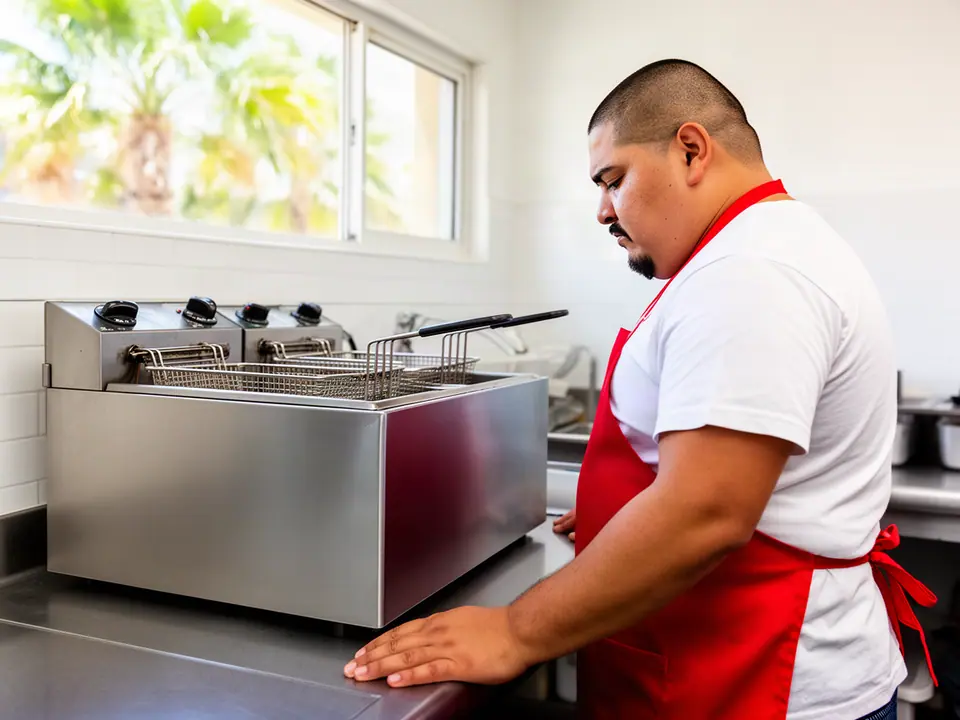
Quick-service restaurant kitchens: fryers, flat-tops and charbroilers
A counter-service kitchen runs on a handful of machines that work every hour the doors are open, and when one of them fails the menu shrinks until it is replaced. Fryers, a flat-top griddle, a charbroiler and a reach-in refrigerator each come from a dealer with a model number and a written quote, and that quote is what an equipment loan is built on. The equipment secures the agreement, so a partner looks at the dealer, the price and the restaurant's deposits rather than at a building.
Kitchens of this kind carry real crews in the county. Madera County, CA counted 97 limited-service restaurants with paid employees in 2023, and only 26 of them, 26.8%, had fewer than five people on staff (County Business Patterns, NAICS 722513). When the fryer line goes down in a kitchen with a full schedule, the shifts are still on the board, so the replacement date matters as much as the price.
Illustration only, invented figures: a quick-service restaurant prices two gas fryers at $9,400, a 48-inch flat-top at $4,200 and a charbroiler and reach-in refrigerator pair at $19,800, $33,400 in all. At 10.25% annually, the $33,400 kitchen package has 48 installments of $851.13, totaling $40,854 with $7,454 of interest.
The hood above the line is a different matter: it is fixed to the building along with its fire suppression system, so it is property work outside this site rather than part of the equipment request. A partner may finance the fryers, griddle, charbroiler and refrigerator on one schedule, each with its own model number on the quote. Loans, leases and finance agreements for the same kitchen package are compared on the equipment financing page.
Sit-down dining rooms: movable furnishings and patio equipment
A dining room can be furnished with movable booths, area rugs, freestanding lighting, a host stand and outdoor furniture, itemized on a term loan with fixed monthly payments. Fixed flooring, paint, restroom fixtures, patio covers and room work are excluded. Patio heaters, outdoor furniture and a new point-of-sale system can go on an equipment agreement when a vendor quotes them on their own.
Sit-down restaurants here tend to be staffed employers rather than one-person operations: of the 66 full-service restaurants Madera County, CA counted in 2023, 45 (68.2%) had five or more employees, by our arithmetic from County Business Patterns (21 had fewer than five; NAICS 722511). In a separate file, ZIP Code Business Patterns placed 9 full-service restaurant establishments at a ZIP 93638 address in 2023; that ZIP and the city limits are not the same area.
Illustration only, invented figures: a sit-down restaurant plans $31,000 of movable booths, area rugs and freestanding lighting and $15,000 for movable patio tables, heaters and freestanding shade equipment, $46,000 in all. A single 60-month loan at 11.5% charges $1,011.66 monthly and $60,700 in all. Split instead, the $31,000 indoor package on the same 60-month terms costs $681.77 a month ($40,906 in total), and the patio furniture on a 36-month agreement at the same rate adds $494.64 a month ($17,807).
The split costs $1,986 less in total than the single loan, because the patio furniture is paid off two years sooner, but for the first three years the two payments together run $164.75 more a month than the single payment. A restaurant with room in its monthly deposits saves; one that needs the lower payment keeps it simple.
Payroll and food costs between deposits in Madera, CA
Food suppliers and payroll are the two bills a restaurant cannot push back, and they keep their own calendars: produce and protein deliveries are paid weekly or on short terms, payroll every one or two weeks, while deposits move with the number of covers the room serves. A gap opens when a large cost lands before the money that pays for it, such as a catering job invoiced to a company that pays on 30-day terms.
Illustration only, invented figures: a restaurant takes a $16,500 catering order, spends $5,200 on food and rentals for it, and invoices the client on 30-day terms. Its biweekly payroll is $11,800, so 2 or 3 paydays fall inside that 30-day wait, depending on where the first one lands: $23,600 to $35,400 of payroll, on top of the weekly supplier bills, before the catering check arrives.
A lump sum on a fixed schedule fits a gap like that, paid off once the invoice clears if the agreement allows early payoff without a charge. The working capital page explains how such a loan is paid back and what a partner reviews before it makes an offer.
Card-sales advances and what to compare first
A merchant cash advance is not a loan. A provider buys a share of future card sales for a sum paid now, then collects a fixed percentage of each day's card settlements until an agreed total has been collected. The two figures to put side by side first are that total and the daily percentage, because together they decide what the money costs and how long collection runs.
In this invented example, a $20,000 advance at a 1.30 factor requires $26,000 of purchased receivables to be collected. The provider holds back 11% of card sales, and on $2,400 of card sales a day that is $264 a day, so collection takes about 99 card-sales days. For comparison, a 12-month $20,000 working-capital loan at 16% costs $1,814.62 monthly and $21,775 overall.
The advance costs $6,000, $4,225 more than the loan's $1,775 of interest in this example, but it finishes sooner and moves with sales: on a day with fewer card sales, less is collected. The loan asks for the same payment every month. How providers collect, and what a factor and a holdback mean, is set out on the merchant cash advance page. County figures for both kinds of restaurant sit on the restaurant funding page, and the full list of Elkmont articles covers other Madera, CA trades.
By Elkmont Loans · Updated