A Madera, CA business choosing between an equipment lease and an equipment loan is choosing who owns the machine at the end, how large each payment is and what the whole agreement costs. A loan makes the business the owner from the first day; a lease keeps ownership with the lessor until a buyout, if there is one. Elkmont Loans passes either request to funding partners, who decide.
An Elkmont Loans article comparing equipment loans, finance agreements and leases for Madera, California businesses, with invented figures.
Who owns the equipment at the end
Ownership is the first difference, and it decides what happens at the last payment. With a loan or an equipment finance agreement, the business owns the equipment from delivery and the lender holds a lien until the balance is paid. With a lease, the lessor owns it and the business pays for its use; what happens at the end depends on the kind of lease.
| Agreement | Owner during the term | At the end of the term |
|---|---|---|
| Equipment loan | The business; the lender holds a lien | The lender releases its lien once the final payment clears |
| Equipment finance agreement | The business | Nothing more is owed once the payments are made |
| $1 buyout lease | The lessor | The business buys the equipment for $1 |
| Fair market value lease | The lessor | Return it, renew the lease or buy at the fair market value then |
How each one appears on the books and in a tax return is a question for the business's accountant, before signing rather than after.
Payment size compared with total cost
A smaller monthly payment does not always mean a smaller total cost, and the two have to be read together with the end-of-term option. Laying out every offer for the same machine in one place makes the trade-off visible.
Illustration only, invented figures: a business prices a $42,000 machine three ways. At 9.75% annually, a 60-month loan costs $887.22 per month and $53,233 altogether. A 60-month $1 buyout lease at $905.00 a month costs $54,301 with the buyout, $1,068 more than the loan. A 48-month fair market value lease at $840.00 a month costs $40,320 if the machine is returned, or $50,720 if the business buys it at an assumed $10,400 fair market value at the end.
In this example the fair market value lease has the smallest payment, $47.22 less a month than the loan, and even with the buyout its total is $2,513 less than the loan, partly because it runs 12 months shorter; but the buyout figure is only an assumption until the term ends, and a returned machine leaves the business with nothing to show for the payments. The $1 buyout lease costs the most of the three. A different assumed buyout or rate can change the order, which is why each offer is worth computing on its own figures.
When the cost is movable furnishings or a second operating location rather than a machine, the comparison is with a business term loan instead; fixed property work is excluded. The equipment financing page works through loans, leases and finance agreements for other machines.
Kitchen and shop equipment that wears out
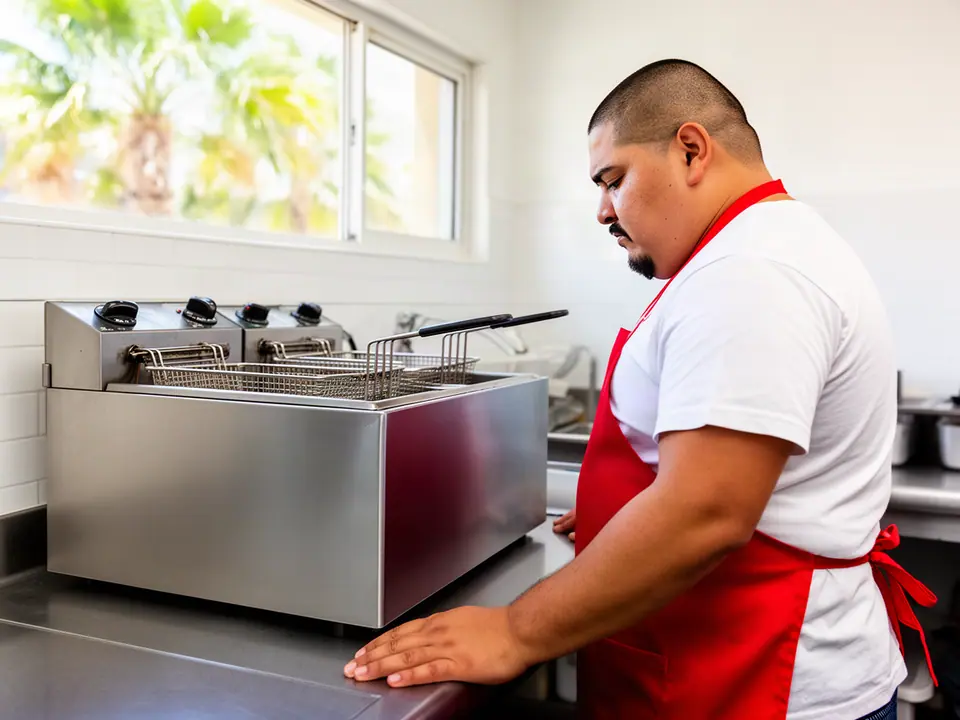
Some equipment is worn out before a long agreement ends: a fryer used every day, a commercial dishwasher, an ice machine, small shop tools, or a diagnostic tablet that the software maker stops supporting. Matching the term to the working life avoids paying for a machine that has already been replaced. Where the business expects to replace on a cycle, a fair market value lease with a return option fits; where the equipment will work long past the term, a loan leaves the business with a machine it keeps using after the payments stop.
Kitchens are one place this matters in the county: Madera County, CA had 201 restaurants and other eating places with paid employees in 2023 (CBP, NAICS 7225), and fryers, ice machines and dish machines are replaced on a cycle in a kitchen of any size. Machine shops are another: County Business Patterns counted 20 fabricated metal product manufacturing establishments in Madera County, CA in 2023 (NAICS 332, which includes machine shops), where cutting tools and fixtures wear out well before the machines that hold them.
Tools and replacement parts that cost a few hundred dollars each do not need an agreement apiece; a business line of credit can carry them and be paid down as the work is billed.
Questions for a dealer before signing
A dealer who offers financing is offering one choice among several. Written answers to these questions make it possible to compare the dealer's offer with others:
- Which party funds the purchase, and is the contract a loan, finance agreement or lease?
- What are the end-of-term options, and is the buyout amount written into the agreement?
- Can the agreement be paid off early, and what would the payoff include?
- Are delivery, installation, training and sales tax part of the financed amount?
- Who pays for maintenance, repairs and insurance during the term?
- Is there a documentation fee or a security deposit, and is the deposit returned at the end?
- What happens to the payments if the equipment fails before the agreement ends?
With those answers in hand, the request form or a call starts a comparison with funding partners, and the Elkmont articles cover equipment for specific trades.
By Elkmont Loans · Updated